Quick start

How to create dependent dropdowns in Google Sheets

Build a four-level Category → Subcategory → Brand → Product picker from one flat table, with no helper sheets and no formulas.

6 min readUpdated August 2026v2.4
01

What you will build

Row 5 of your Orders sheet will contain four dropdowns that narrow each other. Choosing Electronics leaves only Laptops and Phones; choosing Laptops leaves only Lenovo and Apple.

Nothing is generated in hidden tabs. Each cell gets a native Google Sheets validation rule that the add-on rewrites, row by row, as selections change.

Finished four-level row in the Orders sheet
ElectronicsLaptopsLenovoThinkPad X1
02

Prepare the source table

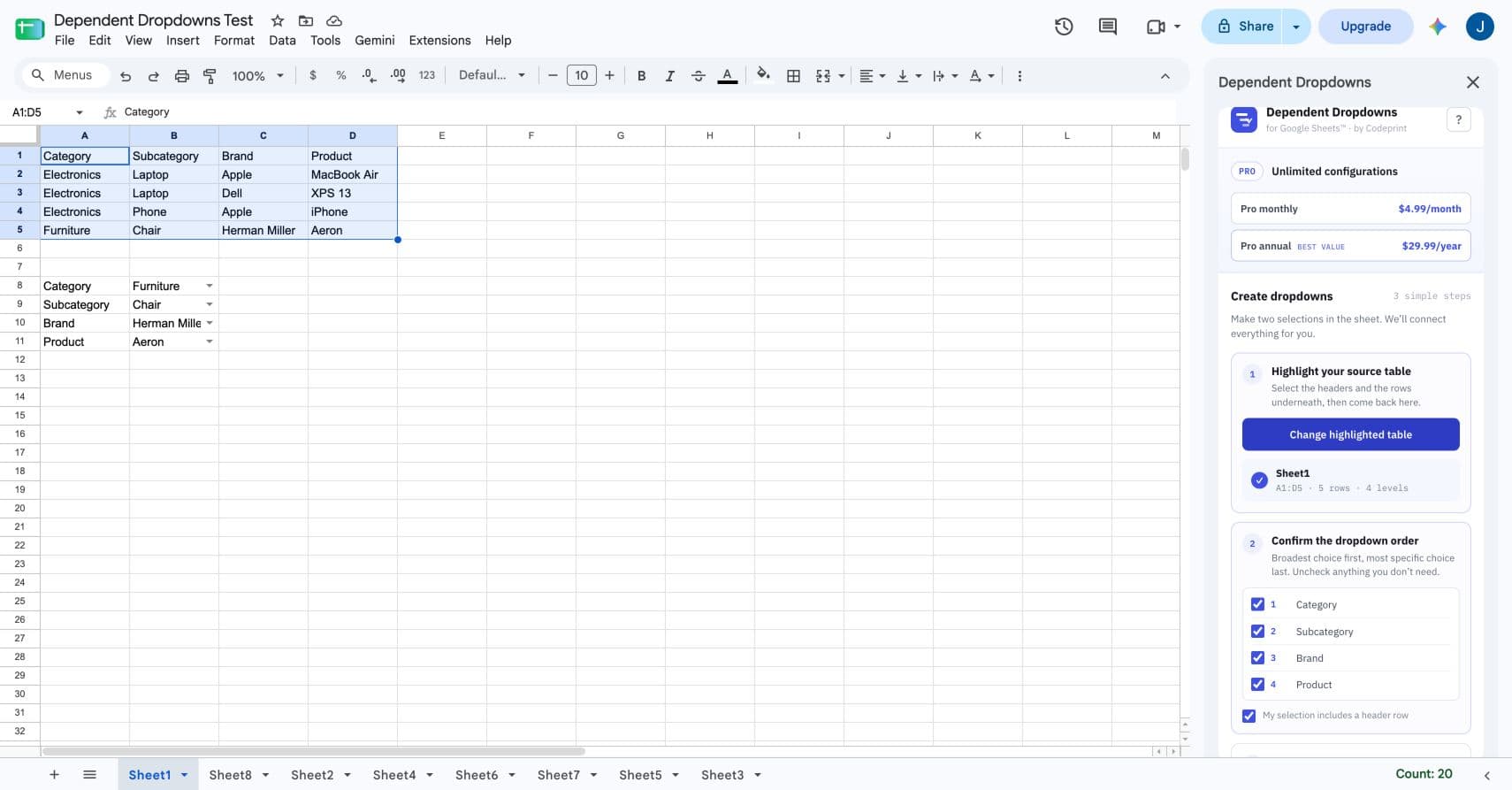
You need one flat table where every row is a valid combination, with parent columns to the left of their children. Copy this into a sheet named Catalog.

Catalog!A1:D7
CategorySubcategoryBrandProduct
ElectronicsLaptopsLenovoThinkPad X1
ElectronicsLaptopsAppleMacBook Air
ElectronicsPhonesAppleiPhone
ElectronicsPhonesSamsungGalaxy
HomeFurnitureIKEAKALLAX
HomeAppliancesDysonV15
Duplicates are fine

Rows are deduplicated per level, so Electronics appearing four times still produces one option.

03

Open Dependent Dropdowns

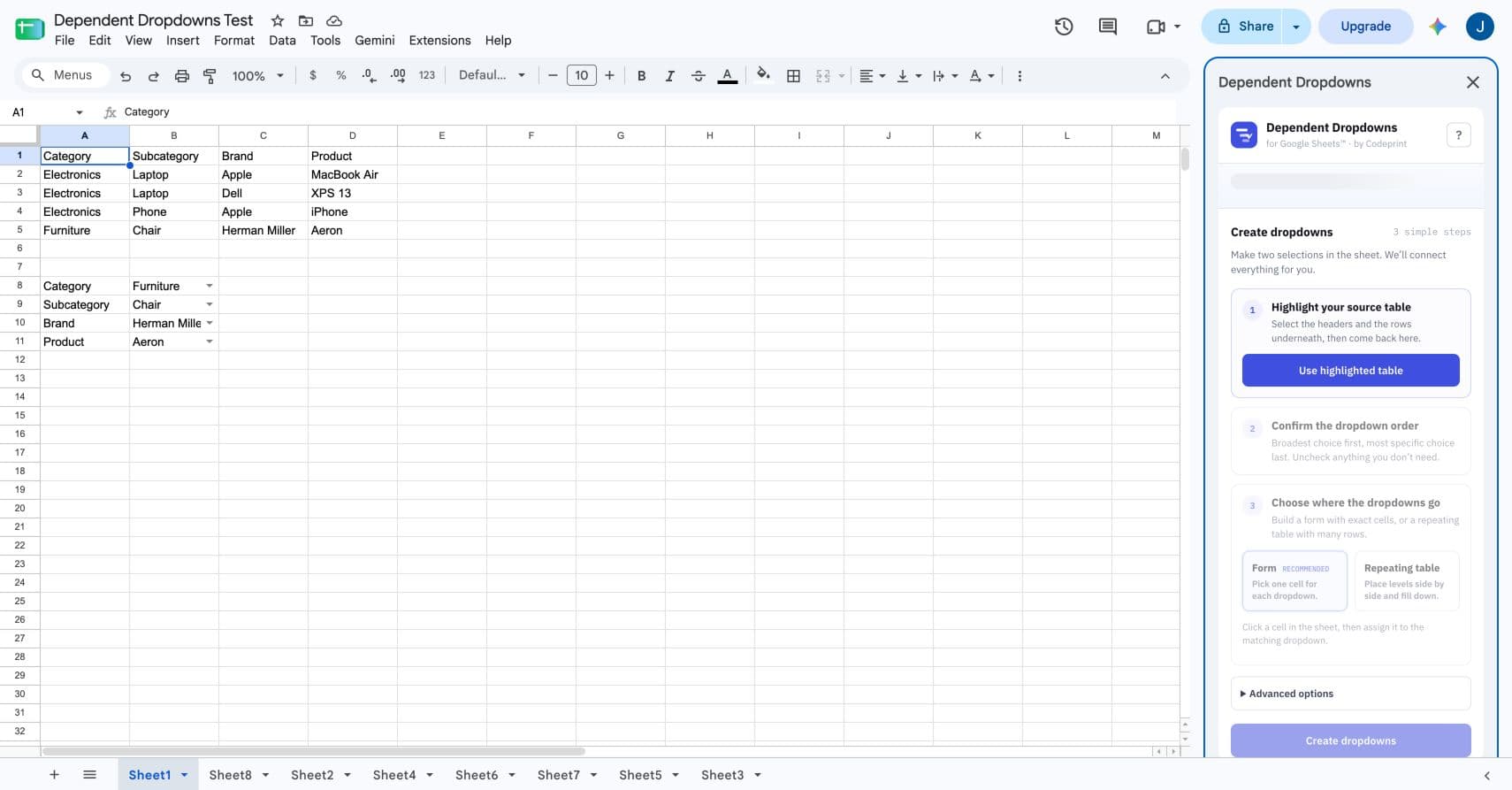
  1. In your spreadsheet, choose Extensions → Dependent Dropdowns → Open sidebar.
  2. Approve the permission prompt the first time.
  3. The sidebar opens on the right and stays open while you work.
04

Select the source range

Name the configuration Catalog picker, select Catalog!A1:D7, then press Load columns. The add-on reads the header row and lists the available columns.

Ranges can be generous

Include empty rows below growing data. Blank rows are ignored and new rows are picked up automatically.

05

Choose hierarchy columns

Add Category, Subcategory, Brand and Product in the order they should cascade. Between two and five levels are supported, and this order—not physical sheet position—decides the hierarchy.

06

Choose the destination

Set the destination to Orders, rows 2–500 and columns B, D, E, H. Columns C, F and G remain completely untouched.

07

Review options

The defaults suit most tables: blanks ignored, duplicates removed, A–Z sorting, whitespace trimmed, case-insensitive matching and invalid downstream selections cleared.

08

Create the dropdowns

Press Create dropdowns. Native validation rules are written into B, D, E and H for rows 2–500. This consumes one free configuration; editing or repairing it later does not.

09

Test the hierarchy

  1. Choose Electronics in B5.
  2. Open D5: it offers Laptops and Phones only.
  3. Choose Phones, then open E5: it offers Apple and Samsung.
  4. Change B5 to Home. Invalid children clear automatically.
Only the edited row recalculates

That is why a 500-row sheet stays fast.

10

Manage or repair

Pause stops updates while preserving values. Resume reapplies rules. Repair rebuilds validation without deleting cell values. Delete removes the configuration and rules while keeping entered values as plain text.

11

Troubleshooting

Dropdown is empty

Re-pick the parent or add the missing source combination.

Options are stale

Choose Repair after source data changed outside an edit.

Typed value is rejected

Pick from the dropdown or turn off strict rejection.

Nothing updates

Reinstall the edit trigger from the sidebar.

12

Next steps

Ready to try it on your own table?

Three free configurations, no card required.

Browse setup guides